
Expert Paralysis Rehabilitation in Ranchi
Paralysis Physiotherapy in Ranchi — Expert Rehabilitation & Recovery at BK Spine Care
Has paralysis taken away your independence, mobility, or quality of life? At BK Spine Care Physiotherapy Clinic in Ranchi, our specialized paralysis physiotherapy program helps patients regain movement, strength, and functional independence — whether caused by stroke, spinal cord injury, nerve damage, or brain injury. With expert care by Dr. Bedprakash Maurya(PT) and home visit physiotherapy available all over Ranchi, recovery starts here.
- 1000+ Patients Treated
- Home Visit Physiotherapy Available
- Personalized Recovery Programs
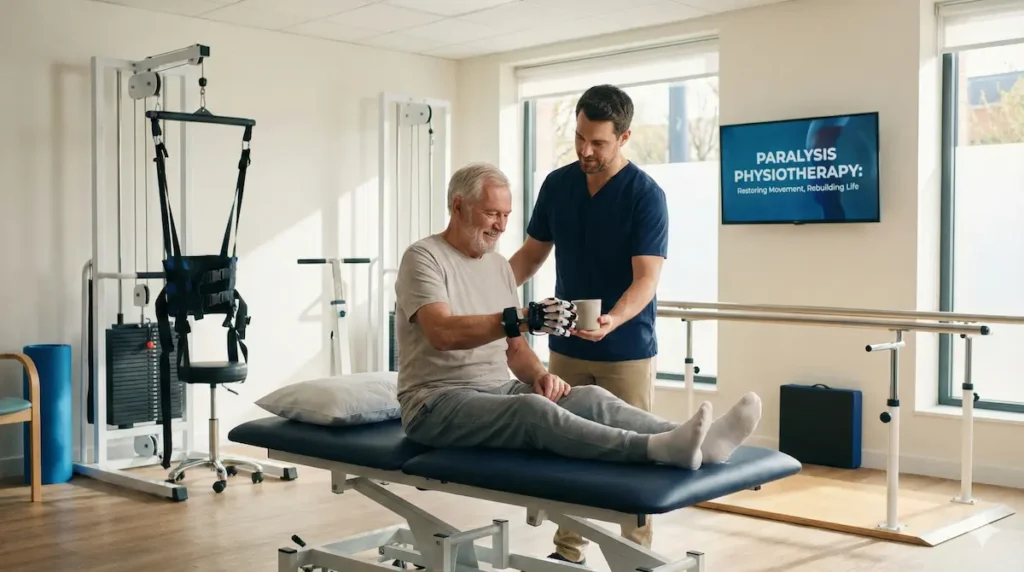
What Is Paralysis & Why Is Physiotherapy Essential for Recovery?
Paralysis is a condition in which a person loses the ability to move one or more muscles in the body. It occurs when the communication between the brain and muscles is disrupted — either due to damage to the brain, spinal cord, or peripheral nerves. Paralysis can affect any part of the body and can be temporary or permanent, partial or complete.
Paralysis physiotherapy (also called neuro-rehabilitation) is the most critical and scientifically proven treatment for helping paralysis patients recover movement, strength, balance, and functional independence. Without timely physiotherapy, muscles weaken further (muscle atrophy), joints become stiff (contractures), and recovery becomes increasingly difficult.
At BK Spine Care Physiotherapy Clinic in Ranchi, our paralysis physiotherapy program is designed and supervised by Dr. Bedprakash Maurya(PT), who has 10+ years of specialized experience in neurological rehabilitation. Our goal is not just to treat paralysis — but to help every patient achieve the maximum possible level of independence and quality of life.
💡 Critical Fact: Research published in the The Lancet Neurology confirms that early, intensive physiotherapy significantly improves recovery outcomes in paralysis patients — especially when started within the first 3–6 months after onset. However, improvements are possible even years after paralysis with consistent rehabilitation.
Many people in Ranchi search for “लकवा का इलाज” (lakwa ka ilaj) or “paralysis ka physiotherapy” — and the answer is clear: specialized neuro physiotherapy is the most effective non-surgical treatment for paralysis recovery. At BK Spine Care, we provide exactly this kind of expert, evidence-based rehabilitation.
Types of Paralysis We Treat at BK Spine Care, Ranchi
Our paralysis physiotherapy in Ranchi covers all types and causes of paralysis. Here’s a comprehensive overview of the types we treat:
🔴 Based on Body Area Affected
| Type of Paralysis | Area Affected | Common Causes |
|---|---|---|
| Hemiplegia | One side of the body (left or right) | Stroke, brain injury, brain tumor |
| Paraplegia | Both legs and lower body | Spinal cord injury, spinal tumors |
| Quadriplegia (Tetraplegia) | All four limbs and trunk | High-level spinal cord injury, severe stroke |
| Monoplegia | One limb (one arm or one leg) | Nerve injury, stroke, cerebral palsy |
| Facial Paralysis (Bell’s Palsy) | One side of the face | Facial nerve damage, viral infection |
| Diplegia | Matching areas on both sides | Cerebral palsy, brain injury |
🟠 Based on Underlying Cause
🧠 Stroke-Related Paralysis
The most common cause of paralysis. A stroke disrupts blood supply to the brain, causing hemiplegia (one-sided paralysis). Our stroke recovery physiotherapy program specifically addresses this.
🦴 Spinal Cord Injury Paralysis
Damage to the spinal cord from accidents, falls, or trauma can cause paraplegia or quadriplegia. Our rehabilitation program focuses on maximizing remaining function and teaching adaptive skills.
🧬 Neurological Disease Paralysis
Conditions like Multiple Sclerosis (MS), Parkinson’s Disease, Guillain-Barré Syndrome, and motor neuron disease can cause progressive paralysis requiring ongoing physiotherapy.
😊 Facial Nerve Paralysis
Bell’s Palsy and other facial nerve injuries cause paralysis of facial muscles. Specialized facial physiotherapy exercises help restore facial movement and expressions.
👶 Cerebral Palsy Paralysis
Children with cerebral palsy may experience various patterns of paralysis. Our pediatric physiotherapy program provides specialized care for these children.
🔌 Peripheral Nerve Injury Paralysis
Damage to individual nerves (e.g., radial nerve palsy, brachial plexus injury, pinched nerves) can cause localized paralysis. Targeted nerve rehabilitation and electrical stimulation help restore function.
Our Paralysis Physiotherapy & Rehabilitation Program at BK Spine Care
At BK Spine Care, our paralysis physiotherapy program in Ranchi follows a comprehensive, phased rehabilitation approach designed to take the patient from the acute stage to maximum functional recovery. Here’s how our program works:
📋 Phase 1: Acute Stage Care (First 1–4 Weeks)
Goal: Prevent complications, maintain joint mobility, prevent muscle wasting
Key Interventions:
- ✅ Proper positioning & bed mobility — Preventing bedsores (pressure ulcers), contractures, and DVT
- ✅ Passive Range of Motion (PROM) exercises — Moving all joints through their full range to prevent stiffness
- ✅ Respiratory physiotherapy — Breathing exercises to prevent pneumonia and maintain lung function
- ✅ Gentle sensory stimulation — Maintaining brain-body connection through touch and proprioceptive input
- ✅ Family education — Training caregivers on proper handling, positioning, and daily care techniques
📋 Phase 2: Sub-Acute Recovery (Weeks 4–12)
Goal: Initiate active movement, start muscle re-education, improve sitting balance
Key Interventions:
- ✅ Active-Assisted Range of Motion (AAROM) — Encouraging the patient to participate in movements with therapist support
- ✅ Neuromuscular re-education — Training the brain to re-establish connections with affected muscles
- ✅ Sitting balance training — Progressive exercises to achieve independent sitting
- ✅ Mat exercises — Rolling, bridging, and transitional movements
- ✅ Electrotherapy (Functional Electrical Stimulation) — Using electrical current to activate paralyzed muscles
- ✅ Spasticity management — Techniques to reduce abnormal muscle tightness
📋 Phase 3: Active Recovery (Months 3–6)
Goal: Increase muscle strength, achieve standing and walking, improve functional activities
Key Interventions:
- ✅ Progressive strengthening exercises — Building muscle power in affected and unaffected limbs
- ✅ Standing balance training — Using parallel bars, standing frames, and tilt tables
- ✅ Gait training (walking re-education) — Learning to walk again with or without assistive devices
- ✅ Weight-bearing exercises — Strengthening bones and muscles through load-bearing activities
- ✅ Functional task practice — Training for daily activities like eating, dressing, grooming, toileting
- ✅ Coordination and fine motor exercises — Improving hand dexterity and coordination for daily tasks
📋 Phase 4: Advanced Rehabilitation (6+ Months)
Goal: Maximize independence, community reintegration, long-term maintenance
Key Interventions:
- ✅ Advanced gait training — Walking on uneven surfaces, stairs, outdoor terrain
- ✅ Community mobility training — Navigating real-world environments safely
- ✅ Home exercise program (HEP) — Independent exercise routine for long-term maintenance
- ✅ Adaptive equipment training — Using wheelchairs, walkers, orthoses, and assistive devices effectively
- ✅ Psychological support — Addressing depression, anxiety, and motivation challenges common in paralysis patients
- ✅ Caregiver training — Advanced training for family members on home care, exercises, and emergency management
Paralysis Physiotherapy Techniques & Methods Used at BK Spine Care
Our paralysis rehabilitation in Ranchi uses a combination of internationally recognized neurological rehabilitation techniques. Dr. Bedprakash Maurya(PT) selects the most appropriate techniques based on each patient’s type of paralysis, severity, stage of recovery, and functional goals.
1. Bobath / NDT (Neurodevelopmental Treatment)
A specialized approach that focuses on inhibiting abnormal muscle tone and movement patterns while facilitating normal, functional movements. Uses hands-on guidance to help the patient “re-learn” how to move correctly.
Best for: Stroke hemiplegia, cerebral palsy, brain injury
2. PNF (Proprioceptive Neuromuscular Facilitation)
Uses spiral and diagonal movement patterns combined with resistance to stimulate the neuromuscular system. Promotes functional strength, coordination, and motor control through natural movement patterns.
Best for: Muscle weakness, poor coordination, all types of paralysis
3. Brunnstrom’s Movement Therapy
Utilizes the synergy patterns that naturally occur during stroke recovery. Instead of suppressing these patterns, this approach uses them as a stepping stone toward voluntary, isolated movement control.
Best for: Stroke hemiplegia patients in early to mid recovery stages
4. Motor Relearning Program (MRP)
A task-oriented approach that focuses on practicing real functional tasks rather than isolated exercises. Based on the principle that the brain learns best by performing meaningful, goal-directed activities.
Best for: Functional recovery, daily activity training, all paralysis types
5. Functional Electrical Stimulation (FES)
Uses electrical impulses to activate paralyzed muscles and produce functional movements. Helps strengthen muscles, reduce spasticity, and improve brain-muscle communication. Part of our electrotherapy services.
Best for: Foot drop, wrist drop, weak grip, muscle atrophy in paralysis
6. Constraint-Induced Movement Therapy (CIMT)
Restricts the use of the unaffected (healthy) limb to force the patient to use the paralyzed limb. This intensive approach promotes neuroplasticity — the brain’s ability to rewire itself and create new neural pathways.
Best for: Hemiplegia patients with some existing movement in the affected arm/hand
7. Balance & Gait Training
Systematic training to improve sitting balance, standing balance, weight shifting, and walking. Uses parallel bars, walkers, canes, and progressive difficulty levels to safely rebuild the patient’s ability to stand and walk.
Best for: All paralysis patients aiming to regain mobility
8. Stretching & Contracture Prevention
Regular passive and active stretching of muscles and joints to prevent contractures (permanent shortening of muscles). Combined with manual therapy and joint mobilization for optimal results.
Best for: All paralysis patients — especially bedridden patients at high risk of contractures
Benefits of Paralysis Physiotherapy at BK Spine Care, Ranchi
Consistent, expert paralysis physiotherapy offers life-changing benefits for patients and their families. Here’s what our rehabilitation program can achieve:
✅ 1. Restores Muscle Movement & Strength
Through progressive neuromuscular re-education and strengthening exercises, paralysis physiotherapy helps reactivate dormant muscles and rebuild lost strength — even months or years after the onset of paralysis.
✅ 2. Prevents Muscle Wasting & Joint Stiffness
Without movement, muscles waste away (atrophy) and joints become permanently stiff (contractures). Regular physiotherapy prevents these devastating complications and maintains muscle and joint health.
✅ 3. Improves Balance & Coordination
Specialized balance training helps paralysis patients achieve safe sitting, standing, and eventually walking — reducing fall risk and building confidence in movement.
✅ 4. Helps Patient Walk Again
Our gait training program has helped numerous paralysis patients in Ranchi walk again with or without assistive devices. From first steps with parallel bars to independent walking — we guide the entire journey.
✅ 5. Restores Daily Activity Independence
Our functional rehabilitation trains patients to perform Activities of Daily Living (ADLs) — eating, dressing, bathing, grooming, toileting, and transferring — reducing dependence on caregivers.
✅ 6. Reduces Spasticity & Abnormal Tone
Our techniques reduce spasticity, relax tight muscles, and restore normal muscle tone — making movement easier and less painful.
✅ 7. Prevents Bedsores & Respiratory Complications
For bedridden patients, physiotherapy includes regular positioning changes, skin care education, and respiratory exercises to prevent life-threatening complications like pressure ulcers and pneumonia.
✅ 8. Promotes Brain Neuroplasticity
Repetitive, targeted exercises stimulate neuroplasticity — the brain’s remarkable ability to create new neural pathways to bypass damaged areas.
✅ 9. Improves Mental Health & Confidence
As patients see tangible progress through physiotherapy, their confidence, motivation, and psychological well-being improve significantly.
✅ 10. Reduces Caregiver Burden
As the patient becomes more independent, the physical and emotional burden on family members and caregivers decreases. We also train caregivers on proper techniques to make daily care easier and safer.
Home Visit Paralysis Physiotherapy in Ranchi — We Come to You
We understand that bringing a paralysis patient to a clinic is often extremely difficult — especially in the early stages when the patient may be bedridden, wheelchair-bound, or unable to travel. That’s why BK Spine Care offers comprehensive home visit physiotherapy for paralysis patients across all areas of Ranchi.
What’s Included in Our Home Visit Paralysis Physiotherapy:
- ✅ Complete assessment at the patient’s bedside by Dr. Bedprakash Maurya(PT)
- ✅ Personalized rehabilitation plan designed for the home environment
- ✅ All physiotherapy techniques — passive exercises, active exercises, balance training, gait training
- ✅ Electrotherapy modalities (portable FES, TENS, IFT) brought to your home
- ✅ Caregiver training — teaching family members exercises and care techniques
- ✅ Regular progress monitoring and treatment plan adjustments
- ✅ Home modification advice — recommendations for making the home safer and more accessible
📍 Areas Covered for Home Visit Paralysis Physiotherapy in Ranchi:
We provide home visit paralysis physiotherapy across: Harmu, Lalpur, Kadru, Ashok Nagar, Morabadi, Ratu Road, Dhurwa, HEC Colony, Hinoo, Pundag, Bariatu, Kanke Road, Doranda, Kokar, Booty More, Kathal More, Hatia, Hindpiri, Namkum, and all other areas of Ranchi.
🏠 Book Home Visit Now: Call +91 7238814752 or WhatsApp us to schedule a home visit for your paralysis patient. Visit our Home Physiotherapy Service page for more details.
Related Conditions Treated Under Our Paralysis Physiotherapy Program
Our paralysis physiotherapy in Ranchi is closely connected to our treatment of the following neurological and musculoskeletal conditions:
🧠 Neurological Conditions
- ✅ Stroke Rehabilitation
- ✅ Paralysis (All Types)
- ✅ Bell’s Palsy / Facial Paralysis
- ✅ Parkinson’s Disease
- ✅ Multiple Sclerosis (MS)
- ✅ Cerebral Palsy
- ✅ Pinched Nerve / Nerve Compression
🦴 Related Spine & Musculoskeletal Conditions
Why Choose BK Spine Care for Paralysis Physiotherapy in Ranchi?
When it comes to paralysis treatment and rehabilitation in Ranchi, choosing the right physiotherapist can make the difference between limited recovery and life-changing transformation. Here’s why families across Ranchi trust BK Spine Care:
👨⚕️ Specialized Neuro Rehab Expertise
Dr. Bedprakash Maurya(PT) has 10+ years of specialized experience in neurological rehabilitation, including stroke, spinal cord injury, and brain injury paralysis. He uses internationally recognized techniques like Bobath/NDT, PNF, and CIMT.
🏠 Home Visit Service All Over Ranchi
We bring complete paralysis rehabilitation to your doorstep. Our home visit physiotherapy covers all areas of Ranchi — because we know that paralysis patients often cannot travel to a clinic.
📋 Comprehensive, Phased Approach
We don’t take shortcuts. Our 4-phase rehabilitation program takes the patient through every stage of recovery — from acute care to community reintegration — ensuring no critical step is missed.
👨👩👦 Family & Caregiver Training
Paralysis recovery is a 24/7 process, not just during therapy sessions. We extensively train family members and caregivers on exercises, handling techniques, positioning, and daily care — multiplying the effect of our treatment.
⚡ Advanced Equipment & Modalities
Our clinic is equipped with Functional Electrical Stimulation (FES), TENS, parallel bars, balance boards, tilt tables, and other specialized neuro rehabilitation equipment. We also carry portable equipment for home visits.
💰 Affordable Packages
We understand that paralysis treatment is a long-term commitment. Our affordable monthly and weekly packages make quality rehabilitation accessible to all families in Ranchi.
Complementary Services for Paralysis Patients at BK Spine Care
Our paralysis physiotherapy is supported by several complementary services that enhance recovery outcomes:
Stroke Recovery Physiotherapy
Specialized stroke rehabilitation for hemiplegia patients with comprehensive recovery protocols.
Neuro Physiotherapy
Complete neurological rehabilitation for all brain and spinal cord conditions.
Electrotherapy (FES, TENS)
Functional Electrical Stimulation to activate paralyzed muscles and reduce spasticity.
Manual Therapy
Hands-on joint mobilization and soft tissue techniques to prevent contractures and improve mobility.
Home Visit Physiotherapy
Complete paralysis rehabilitation delivered at the patient’s home across all areas of Ranchi.
Elderly Care Physiotherapy
Specialized rehabilitation for elderly paralysis patients with age-appropriate, gentle techniques.
What to Expect During Your First Paralysis Physiotherapy Visit at BK Spine Care
Whether you visit our clinic or we come to your home, here’s what the first paralysis assessment and treatment session involves:
📋 Step 1: Comprehensive Neurological Assessment (20–30 minutes)
Dr. Bedprakash Maurya(PT) performs a detailed assessment including: medical history review, onset and cause of paralysis, current medications, muscle tone assessment (spasticity/flaccidity), muscle power grading (Oxford Scale 0–5), sensory testing, reflex testing, balance evaluation, and functional ability assessment (what the patient can and cannot do independently).
🎯 Step 2: Goal Setting & Treatment Planning
Based on the assessment, realistic short-term and long-term goals are set in collaboration with the patient and family. A personalized rehabilitation plan is created with specific milestones, session frequency, and expected timeline.
🔧 Step 3: First Treatment Session (30–45 minutes)
The first treatment begins immediately after assessment. Techniques are selected based on the patient’s current stage — ranging from passive exercises and positioning for acute patients to active exercises and gait training for recovering patients.
👨👩👦 Step 4: Family/Caregiver Education
Before the session ends, Dr. Bedprakash Maurya(PT) trains the family on essential exercises, positioning, and handling techniques that they should practice between sessions. This is one of the most critical parts of successful paralysis rehabilitation.
⏱️ Total First Visit Time: Approximately 60–90 minutes (assessment + first treatment + family education). Follow-up sessions are typically 45–60 minutes.
📅 Recommended Frequency: For best results, paralysis patients typically need 5–6 sessions per week in the early stages, reducing to 3–4 sessions per week as they improve. Dr. Bedprakash Maurya(PT) will recommend the ideal frequency based on your specific case.
Essential Paralysis Exercises That Caregivers Can Do at Home
While professional physiotherapy is essential, consistent home exercises between sessions significantly accelerate recovery. Here are some basic exercises we teach caregivers to perform at home:
⚠️ Important: These exercises should ONLY be performed after proper training from a qualified physiotherapist. Incorrect technique can cause injury. Always consult Dr. Bedprakash Maurya(PT) before starting any home exercise program. Call +91 7238814752 for guidance.
1. Passive Range of Motion (PROM) Exercises
Gently move each joint (shoulder, elbow, wrist, hip, knee, ankle) through its full range of motion. Perform 10 repetitions for each joint, 2–3 times daily. This prevents joint stiffness and maintains flexibility.
2. Positioning & Turning Schedule
For bedridden patients, change position every 2 hours to prevent bedsores. Alternate between lying on the back, affected side, and unaffected side. Use pillows for proper support and alignment.
3. Bridging Exercise
Patient lies on back with knees bent. With caregiver support, lift the hips off the bed. Hold for 5 seconds, slowly lower. Repeat 10 times. Strengthens hip and trunk muscles essential for sitting and standing.
4. Sitting Balance Practice
Help the patient sit on the edge of the bed with feet on the floor. Stay close for safety. Practice weight shifting — leaning gently left, right, forward, and backward. Start with 5 minutes and gradually increase.
5. Hand & Finger Exercises
Practice opening and closing the hand, gripping objects (rubber ball, cloth), and individual finger movements. These fine motor exercises help restore hand function for daily activities.
6. Deep Breathing Exercises
Practice deep diaphragmatic breathing — inhale deeply through the nose for 4 seconds, hold for 2 seconds, exhale slowly through the mouth for 6 seconds. Perform 10 repetitions, 3–4 times daily. Prevents respiratory complications.
Visit BK Spine Care for Paralysis Physiotherapy in Ranchi
📍 Clinic Address
BK Spine Care Physiotherapy Clinic
H-85, Lal Bahadur Shastry Marg, near Sahajanand Chowk,
Harmu Housing Colony, Nizam Nagar, Hindpiri,
Ranchi, Jharkhand 834002
📞 Contact Information
📞 Phone: +91 7238814752
📧 Email: physio@bkspinecare.com
🌐 Website: www.bkspinecare.com
🕐 Clinic Hours
| Monday – Saturday | 9:00 AM – 7:30 PM |
| Sunday | 9:00 AM – 1:00 PM |
🔗 Follow Us
Frequently Asked Questions About Paralysis Physiotherapy in Ranchi
Here are the most common questions families ask about our paralysis physiotherapy services at BK Spine Care:
Recovery depends on the type, cause, severity, and timing of treatment. Many patients — especially stroke hemiplegia patients — can achieve significant to near-complete recovery with early, intensive physiotherapy. Even patients with incomplete spinal cord injuries can regain substantial function. While some patients with severe damage may not fully recover, every patient can improve their level of independence and quality of life through consistent rehabilitation.
As early as possible — ideally within 24–48 hours after the patient is medically stable. Research consistently shows that early rehabilitation leads to significantly better outcomes. However, it’s never too late to start — improvements are possible even years after onset with the right rehabilitation program.
For optimal recovery:
• Acute stage: 5–6 sessions per week (daily or near-daily)
• Sub-acute stage: 4–5 sessions per week
• Active recovery: 3–4 sessions per week
• Maintenance: 2–3 sessions per week
Dr. Bedprakash Maurya(PT) will recommend the ideal frequency based on your specific condition.
The cost varies based on the severity of paralysis, session duration, frequency, and whether clinic or home visit. We offer affordable daily, weekly, and monthly packages specifically designed for long-term paralysis rehabilitation. Please call +91 7238814752 for detailed pricing information.
Yes! Home visit physiotherapy is one of our most requested services for paralysis patients. We provide complete paralysis rehabilitation at the patient’s home — including assessment, exercises, electrotherapy, gait training, and caregiver training — across all areas of Ranchi. Visit our Home Physiotherapy page or call +91 7238814752 to book.
Recovery timeline varies:
• Bell’s Palsy: Often recovers within 3–6 months
• Stroke Hemiplegia: Most recovery in first 3–6 months, continued improvement for 1–2 years
• Spinal Cord Injury: Maximum improvement within first 12–18 months
• Peripheral Nerve Injury: 3–12 months depending on severity
The speed and extent of recovery depend heavily on the consistency and quality of physiotherapy.
Yes! While early treatment gives the best results, improvements are possible even in chronic/old paralysis. Through neuroplasticity-based techniques, consistent exercise, and electrical stimulation, we have helped patients improve their function even 2–5 years after onset. It’s never too late to start rehabilitation.
Most paralysis exercises require minimal equipment. We bring necessary portable equipment during home visits. Having the following at home is helpful:
• A firm bed (not too soft)
• Pillows for positioning
• A wheelchair (if the patient cannot walk)
• A rubber ball for hand exercises
• Non-slip mat for balance exercises
Dr. Bedprakash Maurya(PT) will advise on specific equipment needed.
Yes, BK Spine Care Physiotherapy Clinic functions as a paralysis rehabilitation center in Ranchi, providing comprehensive neuro rehabilitation for all types of paralysis. We offer both clinic-based and home-based rehabilitation programs. Our services include neuro physiotherapy, stroke rehabilitation, and this paralysis physiotherapy program.
Paralysis physiotherapy (neuro rehabilitation) requires specialized knowledge and techniques different from general musculoskeletal physiotherapy. It involves neurological assessment skills, understanding of brain neuroplasticity, specialized techniques like Bobath/NDT, PNF, and CIMT, spasticity management, and functional retraining for activities of daily living. Dr. Bedprakash Maurya(PT) at BK Spine Care has specific training and extensive experience in this specialized field.
Don't Give Up — Paralysis Recovery Is Possible.
Every day without physiotherapy is a day of potential recovery lost. Start your paralysis rehabilitation today with Dr. Bedprakash Maurya(PT) at BK Spine Care — Ranchi’s trusted paralysis physiotherapy specialist.
Clinic visits & home visits available. We come to you anywhere in Ranchi.
🕐 Monday – Saturday: 9:00 AM – 7:30 PM | Sunday: 9:00 AM – 1:00 PM
